Nanjing Yufeng Intelligent Technology Co., Ltd. (hereinafter referred to as “Yufeng Intelligent”)The company, which has been in business for more than five years, has a team of just ten people. After receiving a development request last year, it launched the industry’s first airbag designed for eVTOLs just last month. As soon as the product hit the market, the company already had more than twenty orders in the pipeline.
An Extreme Test at a Height of Two Meters
eVTOL, which stands for “electric vertical takeoff and landing aircraft” and is also known as a “flying car,” is an electric aircraft that does not require a runway and can take off and land from a standing position.In recent years, this type of ultralight aircraft has seen rapid development both domestically and internationally. Overseas, some companies have already obtained sales licenses, with orders extending several years into the future; domestically, leading companies such as Yingwu Intelligent have also delivered dozens of units and established regular operational experiences at some tourist attractions.
But one core issue remains: Getting it to fly isn’t the hardest part; the key is to make people feel confident and comfortable enough to fly it. This is especially true when it comes to safety measures, for which there has long been no mature solution.Yufeng Intelligent aims to fill this gap.
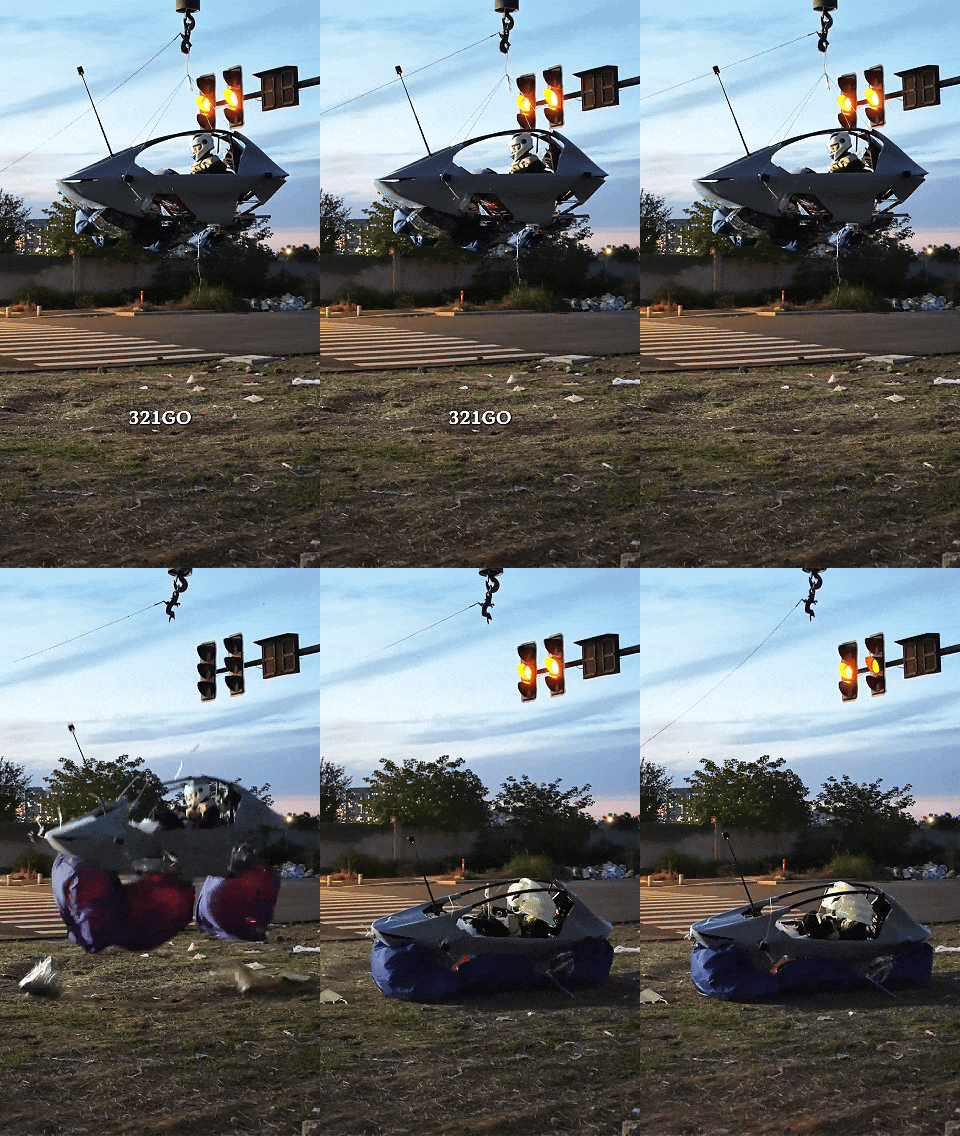
A test recently completed at the Science City in the Jiangbei New Area demonstrated that their product has taken a crucial step forward—that evening, a crane slowly lifted an eVTOL manufactured by Yingwu Intelligent two meters off the ground. From an industry perspective, a height of two meters is too close to the ground; a parachute simply wouldn’t have time to fully deploy, rendering traditional safety measures virtually ineffective at this altitude. After installing his team’s airbag safety system, Liu Bin, founder of Yufeng Intelligent, confidently took his seat inside the aircraft.
As soon as the command was issued, the aircraft plummeted instantly. Within 0.2 seconds, the system completed fault detection and attitude assessment; at 0.3 seconds, the airbags fully deployed. The moment the aircraft touched the ground, three sets of airbags precisely absorbed the impact, and Liu Bin landed safely.
Shortly thereafter, Chen Yuan, co-founder of Yingwu Intelligence, who had also arrived at the scene, personally took a seat in the vehicle to conduct a test. With these two young entrepreneurs conducting two real-world tests, a crucial step has been taken toward the use of airbags to protect manned aircraft within the industry.

Accumulation of Three Core Technologies
This airbag system, which has caught the industry’s attention, is not the result of a single flash of inspiration, but rather stems from Yufeng Intelligent’s long-term accumulation of technological expertise. Liu Bin attributes this to three key areas.
The first is the technique for deploying a parachute at extremely low altitudes.A parachute is one of the best safety measures for high-altitude activities, but in practice, the higher the altitude, the more effective it is; the lower the altitude, the less effective it becomes. Currently, similar products on the market generally require a deployment altitude of 60 meters or higher, while Yufeng Smart has achieved deployment at 15 meters.
The second is pose recognition technology.When an aircraft crashes, it may fall vertically or roll over or capsize; the protective requirements vary significantly depending on the attitude. Liu Bin’s team can use sensors to capture real-time data such as speed, acceleration, and angle, enabling them to assess the aircraft’s status in a very short time and determine which protective measure to activate.
The third is airbag cushioning technology.An eVTOL is, by its very nature, an ultralight aircraft; if the airbag is too heavy, the aircraft cannot support it, but if it is too light, it cannot withstand the sudden pressure surge. After years of comparison and testing, Liu Bin designed a multi-layered, gradient pressure-relief structure that makes the airbag both lightweight and effective—it can deploy rapidly within 0.3 seconds while ensuring sufficient cushioning upon landing.
“Many people’s first reaction is, ‘Isn’t this just a scaled-up version of a car airbag?’ But that’s not the case at all,” said Liu Bin. “The materials, structure, gas volume, and deployment mechanism all have to be redesigned from scratch.”
In addition to low-altitude operations, based on this set of common perception algorithms and airbag trigger technology,Yufeng Intelligent has also developed a product designed to “catch a fall”—a fall-prevention vest for the elderly.The vest is equipped with built-in sensors that track changes in body posture thousands of times per second. As soon as a fall is detected, the airbags deploy instantly to protect the head and hips. Reportedly, this is currently the only fall-protection vest on the market that offers 360-degree all-around protection; it sold several hundred units as soon as it was launched last year.
Although the team currently consists of only ten people, Liu Bin has always maintained a personnel structure in which R&D staff make up a high proportion of the workforce.His thinking is very clear: Solving cutting-edge technical problems isn't about having a large team, but about having the right people in key positions.
As the low-altitude economy continues to gain momentum
Aircraft Safety Protection
It is shifting from a “bonus” to a “must-have”
We look forward to the future in Nanjing, this fertile ground for innovation,
Yufeng Intelligent continues to build on its solid technical foundation
Ensuring Safety for More Low-Altitude Flights