- In Uzbekistan, a thousand miles away, high in the sky at a height of 100 meters, a wall-climbing robot is moving vertically up a wind turbine tower, cleaning grease from the surface;
- At the construction site of the Huan Dao Road Tunnel on the Xiamen-Jinmen Bridge (Xiamen section), a robot is steadily “on the job” dozens of meters underground, quickly replacing the cutter rings on the tunnel boring machine;
- At the Dongjiang Reservoir in Hunan, a green “little boat” stands out; as it nimbly navigates the waters, it carries out the “precise task” of measuring depths of 44.69 meters…
Climbing walls, changing tools, and taking measurements—these robots, which are truly showing off their capabilities, all come from Jiangbei; whether in the sky, underground, or underwater, what were once considered extreme operating environments now have entirely new solutions.

01 The nation’s first machine with an underground tool changer
At the construction site of the Huan Dao Road Tunnel on the Xiamen-Jinmen Bridge (Xiamen section), dozens of meters underground, the “Xiajin” shield machine is preparing to tunnel through the river and across the sea.Recently, a robotic “doctor” developed by China Railway 14th Bureau made its debut and successfully replaced the “teeth” on a tunnel boring machine’s cutterhead.
“Teeth” refers to the cutting bits on the shield machine’s cutterhead, which bear the heavy responsibility of cutting through rock and soil but wear down extremely quickly and require frequent replacement. In the past, three workers would typically enter the tunnel under pressure. In that cramped, damp, and dimly lit space, it would take them several days to replace a single cutter, making the process extremely arduous.

Not long ago, this blade replacement effort entered a new phase—A robot developed by China Railway 14th Bureau has been put into service; this is also China’s first heavy-duty intelligent shield machine blade-changing robot.The
According to reports, this robot has 11 independently controllable joints. With a load capacity of 500 kilograms and a flexible, telescoping design, it can cover the entire cutterhead of ultra-large-diameter shield machines ranging from 10 to 18 meters in diameter, easily grasping heavy-duty cutting tools and replacing them with precision.
Entrusting the extremely difficult task of tool changing to robots not onlyThe time required to replace a single hobbing cutter has been reduced to 25 to 40 minutes...and the entire process can be carried out without any personnel entering the chamber, ensuring construction safety. What’s more, the robot’s entire system—including both hardware and software—is 100% domestically produced and features fully independent intellectual property rights.
02 Whether in the sky or the sea, there are new zones
A shield machine blade-changing robot is blazing a new trail dozens of meters underground. At the same time, robots “made in Jiangbei” can be found in the sky and underwater.
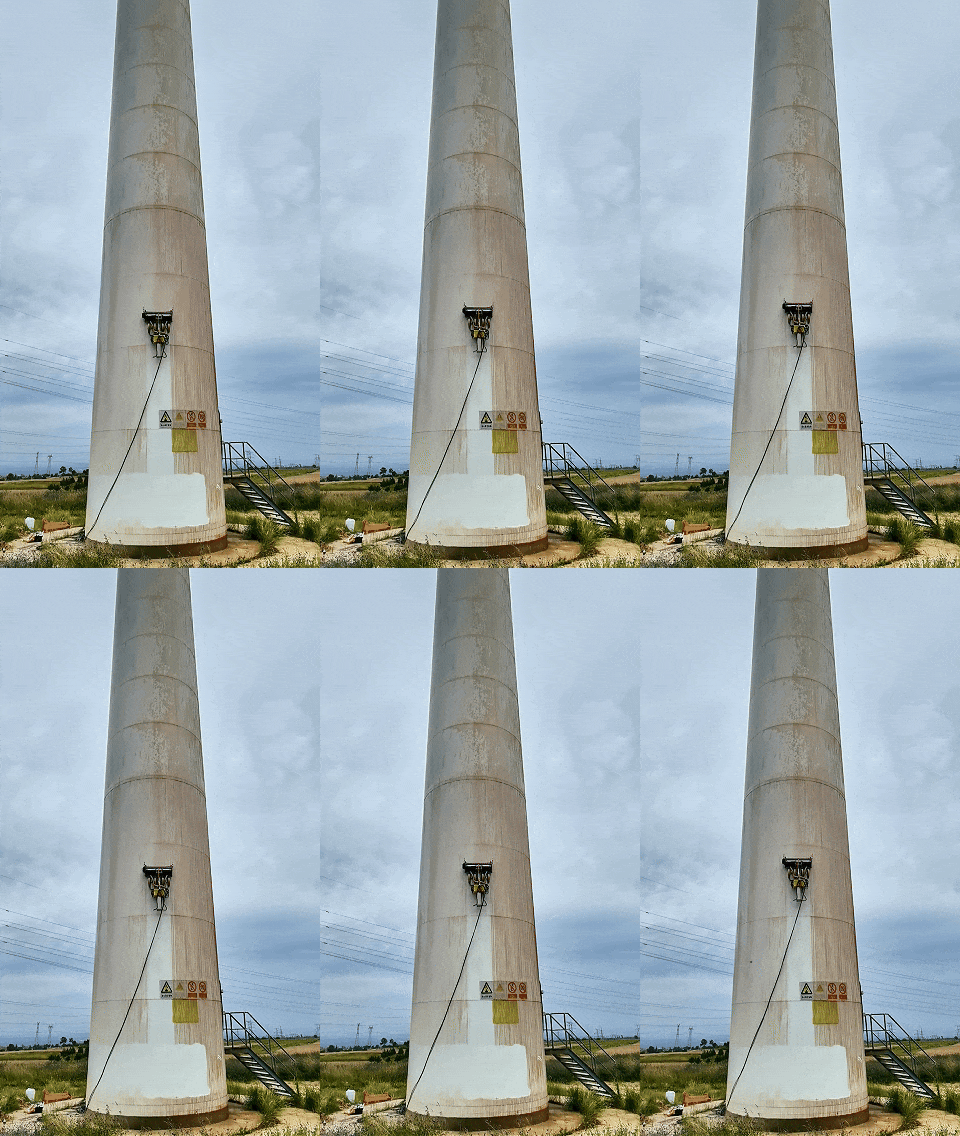
For example, a wall-climbing robot developed by Xinghe Huineng, a company based in the New District, has already been put to work “up in the air” at a wind farm in Uzbekistan. This robot can move freely along the vertical surfaces of wind turbine towers, much like a gecko, to quickly clean off oil stains. In the past, such high-altitude work could only be performed by “spidermen” suspended in mid-air, who had to proceed inch by inch. Especially in inclement weather, workers were required to evacuate as soon as wind speeds exceeded 6 meters per second.
“Our robots continue to operate as usual even in strong winds of 15 meters per second,” said Gu Zenghui, founder of Xinghe Hui Neng,The team has launched a range of robots that cover the entire wind power O&M process, including weld inspection, tower cleaning, and anti-corrosion spraying.... has established business partnerships with China’s five major power generation groups, including Huaneng and Huadian, and has nearly 1,000 units on order.
Another example is Zhonghaida, a company based in the New District, which has launched the iBoat series of intelligent unmanned survey vessels. Just last month, the technical team traveled to Dongjiang Lake in Chenzhou, Hunan, where they completed extreme bathymetric verification in the complex environment of a reservoir with an average depth exceeding 50 meters. Ultimately, the measured depth reached 44.69 meters, with stable and reliable data throughout the entire process.
“With unmanned survey vessels, people no longer need to enter the water to perform dangerous tasks,” explained Song Baoxiong, general manager of Zhonghaida,These “small vessels” have become the backbone of China’s high-end underwater detection equipment and have even made their way overseas, where they are sold to markets around the world.. Just as envisioned when the company was founded, their “journey” lies among the stars and the vast ocean.
03 Where Does This Confidence Come From? Ecology Provides the Answer
In the sky, underground, and underwater—wherever extreme operating conditions exist, that’s where they can be found. This is the track record of the robots in the Jiangbei New Area. Where does this confidence to “go to the sky, underground, and underwater” come from?
A set of data points highlights the approach to solving this problem: Led by industry leaders such as Nanjing Automobile, CRRC, and Sumec, this dynamic region has attracted companies across the entire supply chain of the smart transportation and high-end equipment manufacturing industries.More than 300. It can be said that the impressive performance of these robots is the result of the New District’s years of dedicated efforts and strategic planning in the field of high-end equipment manufacturing.

A deeper driving force comes from the increasingly vibrant industrial ecosystem in this region.
Here, specialized platforms such as the Jiangsu Provincial Digital Economy Society’s Humanoid Robot Industry Research Institute and the Embodied Intelligence Robot Standardization Promotion Center have been established one after another to chart the course and set standards for the industry’s development; the latest 1 billion yuan industrial investment fund under the umbrella fund has just been officially announced, with smart manufacturing and robotics as its key investment targets; A task force dedicated to advancing the embodied robotics industry—jointly established by multiple departments—is working tirelessly to attract major players and support enterprises in growing together…
With all the necessary elements in place, this “old friend” is growing rapidly.The main structure of the Jicui Intelligent Manufacturing Industrialization Base for 10,000 Embodied Intelligent Robots has been topped out. The project has set a clear goal for 2026: to sell more than 4,500 robots and collaborate with 100 academic institutions to build an innovation ecosystem.
"New partners" are also coming in droves... Jinzhou Tianchuang Specialized Embodied Intelligence Headquarters has been established in the New District, with the goal of building the largest robotics production base in East China. The story of industrial clustering is vividly unfolding through a series of concrete projects.

When wall-climbing robots scale wind turbine towers in Central Asia, when tool-changing robots venture deep into the tunnels of the Xiamen-Jinmen Bridge, and when unmanned vessels survey rivers and streams thousands of li away—the high-end equipment from the Jiangbei New Area has long since moved beyond factory floors and workshops to take on the world’s most challenging work sites.
From “reaching for the skies” to “delving into the earth” and “diving into the sea,” every extreme environment the Jiangbei Institute of Robotics has explored is redefining the scope and depth of “smart manufacturing in the New District.”